Architecture
A Subtle but Important Distinction
Not all data platforms fail for the same reasons. The difference is rarely about capability alone — it is about where responsibility for complexity sits.
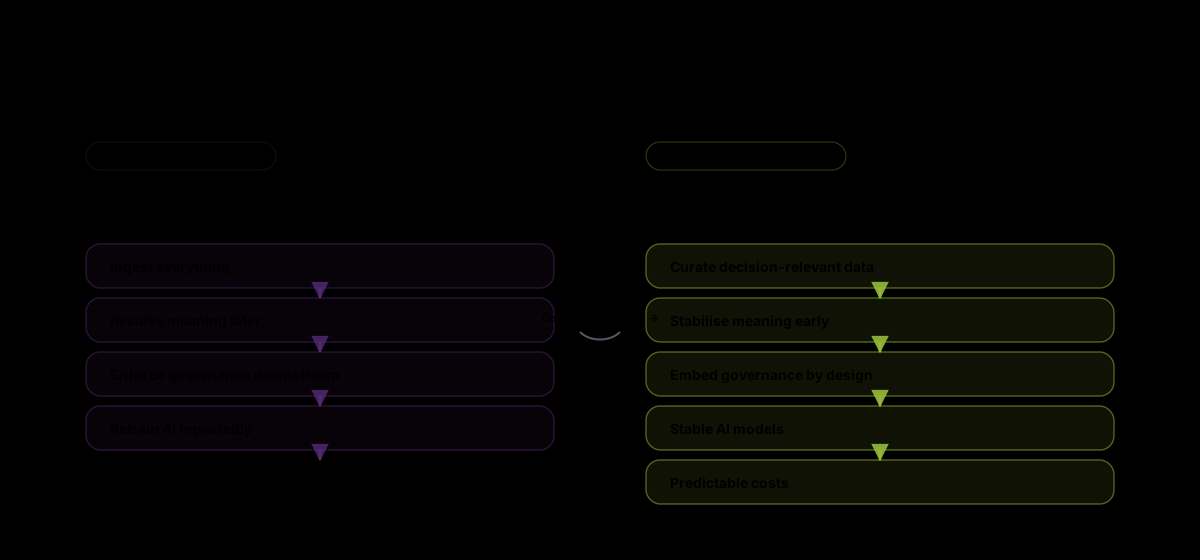
In many modern architectures, complexity is pushed onto the organisation:
- Data meaning is resolved downstream
- Governance is enforced after ingestion
- Quality is monitored, not guaranteed
- Cost control relies on discipline, not design
- AI stability depends on constant retraining
These platforms are powerful, but they assume a level of architectural maturity, operational rigour, and ongoing engineering investment that most organisations underestimate.
By contrast, an emerging class of architectures takes the opposite stance:
- Meaning is stabilised before data is exposed
- Governance is embedded directly into the data fabric
- Only curated, decision-ready data is stored analytically
- Costs are constrained structurally, not operationally
- AI models remain stable as source systems evolve
The distinction is subtle, but the business impact is not.
In the first model, success depends on continuous effort.
In the second, success depends on architectural intent.
Why This Matters to Architects
Architects are often asked to justify decisions in terms of:
- Market leadership
- Feature completeness
- Ecosystem maturity
But the business ultimately judges architecture by different measures:
- How fast insight is delivered
- How predictable costs remain over time
- How resilient AI initiatives are to change
- How easily the organisation adapts without re-engineering
Architectures that internalise complexity may look simpler to buy — but they are harder to live with.
Architectures that absorb complexity by design tend to look quieter in the market, but louder in results.
The Counter-Quadrant Question
Rather than asking:
“Which platform leads the market?”
A more useful question is:
Where does complexity live — and who pays for it over time?
That question rarely appears in analyst graphics.
It appears very clearly in operating costs, delivery speed, and AI outcomes.
Solution Architecture
This video gives you an overview of the CryspIQ® solution architecture and how things hang together.
Data Model
This video gives you an overview of the CryspIQ® Data Model and how it works.
Functional Flows
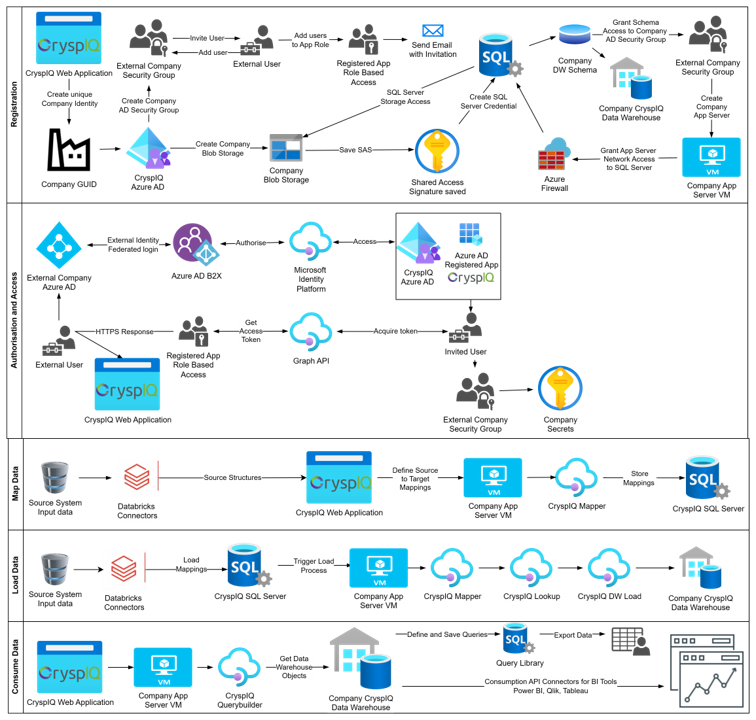
The diagram below provides the functional flows for the end to end concepts of the CryspIQ® application.
Azure Components
The diagram below provides the key Azure components that are required by CryspIQ® for your own business's instance.

This provides and indicative understanding of what azure components you will need and what azure costs could be incurred.