Architecture
CryspIQ® has a deliberately short architecture. Data arrives from your source systems, is mapped into a single governed enterprise data model, and is consumed from there — by reports, by applications, and by people asking questions in plain language.
The thing to understand first is what is absent. There are no staging, transformation and presentation layers to build and maintain between the source and the answer. The model exists before your data arrives, so the work is connecting sources to it rather than designing somewhere for them to go.
The shape of it
Three stages, in order.
1. Connect and map
Sources are registered and their structures described. That can be a file upload, a database, an API or an existing raw or staging layer you already populate — CryspIQ® is happy to read from a lake or warehouse you have rather than replace it.
Each source field is then mapped to its place in the enterprise data model. Lumen proposes those mappings and a person confirms them, which is what keeps the step in business language rather than engineering.
2. Model
Mapped data is loaded into the enterprise data model, where each incoming record is decomposed into typed elements stored against shared dimensions. Two things happen at this point rather than later:
- Quality is assessed as data loads, against rules attached to the model — so a defect is caught at entry rather than found downstream by whoever consumed it. Records that fail are held for a steward rather than silently dropped.
- Business meaning and security classification are attached, carried on the fact type, so both travel with the data into everything that reads it.
3. Consume
Everything downstream reads the same model, which is what makes the answers agree:
- a query library of saved, governed queries
- a query builder for building new ones visually
- natural language questions, answered by Lumen
- dashboards and BI tools
- application-to-application access for operational systems
Because access control is applied to the data rather than to a reporting tool, a person sees the same permitted subset whichever route they use.
Where it sits relative to what you already have
CryspIQ® is not a replacement for your data platform. It has its own storage and compute on Azure SQL Database and runs alongside Databricks, Snowflake, Redshift, Synapse or BigQuery. Its connectors normally map directly from source systems, and it can also read from the raw or staging layers you already populate.
That matters for how a deployment starts: there is no migration to complete before value appears. Map one source, and that source is queryable through the model while everything else carries on unchanged. See co-existence for the detail.
The functional flows
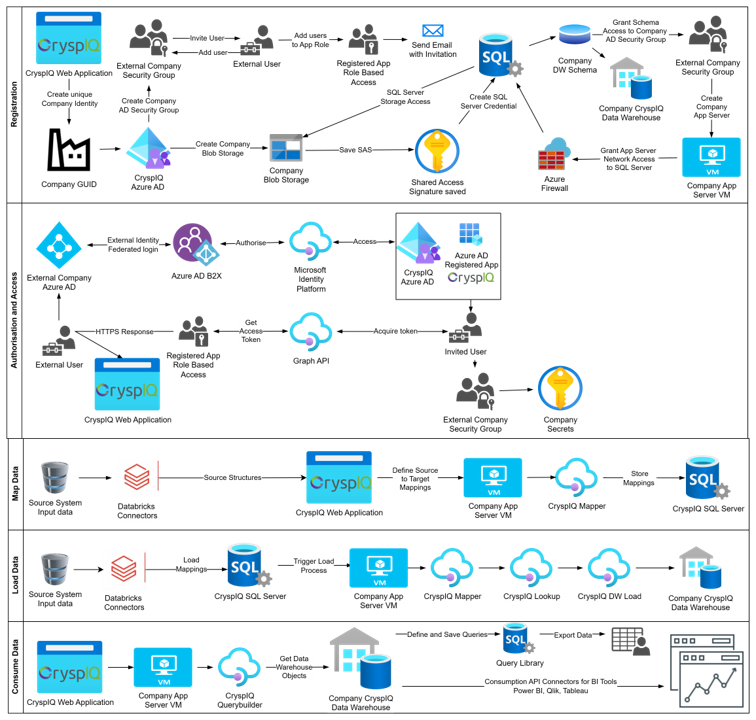
The diagram below shows the end-to-end flow through the application — from source registration and mapping, through load and quality, to the consumption surfaces described above.
What a deployment needs
CryspIQ® is delivered as software as a service, running on Azure. Each customer has their own instance and their own database — your data, your mappings and everything Lumen learns from your confirmations stay within your deployment.
The diagram below shows the Azure components a deployment uses, which is also the basis for understanding the infrastructure cost involved.

Watch
Two short walkthroughs covering the same ground visually.
Solution architecture — how the pieces fit together.
The data model — how data is structured once it arrives. The written version is The CryspIQ® Data Model.
Related
- The CryspIQ® data model — the dimensions, the seven fact stores, the fact type and the link key
- The CryspIQ® methodology — the method and the patent behind the model
- Co-existence — running alongside your current platform
- Lumen AI — the mapping suggestions and natural language layer
- Data quality — how quality is scored and stewarded
- What a data platform does not provide